![Singular-Genomics-Logo---White.png]](https://knowledge.singulargenomics.com/hs-fs/hubfs/Images%20and%20Graphics/2_Singular%20Logos/Singular-Genomics-Logo---White.png?height=40&name=Singular-Genomics-Logo---White.png)
This results in a partially open bubble product that migrates slower on instruments for size determination, such as the Bioanalyzer (Figure 1).
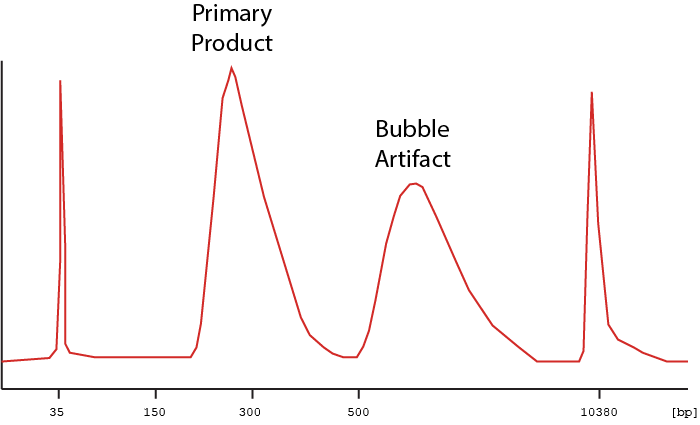
Bubble products form when primers are not in excess anymore during PCR. In that case, instead of primers annealing to the library fragment, two library fragments may anneal to each other, forming a bubble product.
Bubble products may be caused by too much input, or too many cycles of PCR. Therefore, you can minimize bubble product formation the following ways:
• Quantify input using a fluorometric-based method as accurately as possible
• Use the recommended input amount for the library prep method.
• Use the recommended number of PCR cycles for the library prep method.
Bubble products can be sequenced, because once denatured, the single-stranded DNA products will behave the same as the ones from a clean library prep. However, be aware that fluorometric quantification will be inaccurate, it underestimates the amount of DNA present in bubble products. Use a qPCR-based method to quantify a library that contains bubble products.
For more information, see the G4 Best Practices and Quality Control Guide, reach out to your Field Application Scientist, or contact Customer Care.
October 2023